Posts

Showing posts with the label Advertising

In Praise of Conformity

Image
Last week at the Cannes Lions Festival, the best minds in advertising gathered once again to celebrate creativity. Awards were handed out for what was different, daring, disruptive, and of course, “never-seen-before.” Funnily, for a festival that champions difference, the crowd looked remarkably…similar. Black or white t-shirts, jeans or linen trousers, sneakers, and perhaps a blue or black linen blazer to complete the uniform. The same happens at weddings—no matter how much we desire to stand out in the event, our hand automatically reaches for a kurta or a saree, even if it hasn’t seen the light of day in years. Why, have you ever noticed that at office parties, someone will eventually play “Summer of '69,” and as if it’s encoded, everyone in office joins the chorus of singing it together. There is something oddly comforting in sameness. Not just in rituals, but in behaviours, gestures, even aspirations. For a society that prides itself on diversity, we seem to hold a deep and en...

Why Storytelling Beats Data-Driven Pitches in Marketing

Image
  This Diwali holidays, apart from the regular cleaning of the house, I also spent time clearing out old files, an archive of past pitch decks/presentations, from my laptop to save space. As I went through these remnants of previous efforts, one thing became clear: the pitches that resonated most with clients and were successful, were those that was anecdotal rather than data-heavy. Rather than charts, graphs, and research reports that dominated the slides, it was structured narratives, telling a story that clients connected with. What kept me thinking was, why do we instinctively lean towards stories, and why do stories often win over data? Our everyday interactions offer clues. Stories, whether in advertising, news, or casual conversations, are more memorable and engaging than standalone facts. Psychologists have long suggested that humans are “wired” for stories. Studies such as those by Daniel Kahneman, author of Thinking, Fast and Slow , reveal the power of heuristic biases—me...

In Search of Stillness

Image
It’s Diwali time, and most brands release festival films that aim to capture the spirit of the festival, their brand essence, and oodles of emotions in their storytelling. One such film I came across is the new Parle G Biscuits Diwali ad (link here ). The film tries to revive cherished memories of traditional Diwali celebrations, which are often lost in today’s ‘instant’ world. Yet, the brand fit feels forced, especially with the image of a boy carrying a pack of biscuits that stands out awkwardly. And somewhat abruptly, the ad transitions into a message about finding happiness in the happiness of others. But, looking at the YouTube comments and the number of views (13+ Million in the last count)…the film seem to pull the right chords. What struck me, however, was an unspoken idea the ad triggered—the idea of waiting. Maybe my recent article on the ‘weight’ of communication subconsciously resurfaced, nudging me to reflect on how we are losing the fine art of waiting. Waiting, once an ...

The Hefty Communication

Image
How Weight Influences Perception and Engagement in Communication In the world of advertising, the debate between traditional and digital media has become almost as enduring as the mediums themselves. While digital platforms increasingly dominate the contemporary landscape, many industry veterans still swear by the effectiveness of print ads, direct mailers, and other tangible forms of communication. Their reasoning might not simply be nostalgia or a Neo-Luddite behaviour —it could hinge on something more substantial: the weight of the medium itself. I remember as a child, my mother used to judge the quality and perceived usefulness of kitchenware—typically stainless steel—often by its weight. The same held true for furniture or household items; heavier meant better. Even plumper children were once considered "healthier." Seen through a different lens, the concept of weight as a proxy for value shows up in the metaphor “penny wise, pound foolish.” Beyond the monetary differenc...

AI Picture is worth a 1,000 lies

  How AI-Altered Images impacts the Integrity of Marketing, Social Media, and Communications I'll start out by saying that AI-altered images represent a powerful transformative tool, revolutionising the way brands engage with their audience. Take, for instance, a fashion brand utilising AI to retouch photos for a sleeker, more polished look. With the capacity to enhance visuals, correct imperfections, and create aesthetically pleasing content, otherwise which will have to be made from the scratch - increasing time & expenses, AI offers marketers an unprecedented level of creative control. This ability to craft captivating imagery that can elevate brand perception, attract consumer attention, and drive engagement in a digital world - where visual content is the key to drive competitive advantage. But in today's marketing, the allure of perfection through product or communication has become an irresistible temptation.  And my thoughts are more fundamental. With artificial in...

A Zen Perspective on Building Authentic Connections with Consumers

Image
  Wishing you all a very Happy New Year! I began delving deeper into Zen philosophy during the Covid lockdown, became hooked, and now make effort to incorporate its principles into my day-to-day life. As a marketing consultant, I occasionally attempt to integrate Zen-inspired strategies into marketing too. Some interesting concepts have emerged and I wanted to share my thoughts with you. In the fast-paced world of marketing, where trends come and go and consumer preferences evolve rapidly, brands often find themselves navigating turbulent waters. In this dynamic landscape, the timeless principles of Zen philosophy can serve as a guiding light for marketers seeking to establish genuine connections with their audience.  Embrace Simplicity: At the core of Zen philosophy is the principle of simplicity. In a world bombarded with information, consumers appreciate brands that cut through the noise and convey their message with clarity. In my experience, I’ve seen that simplifying pro...

Can Advertising Agencies Look at Value-Based Compensation?

Image
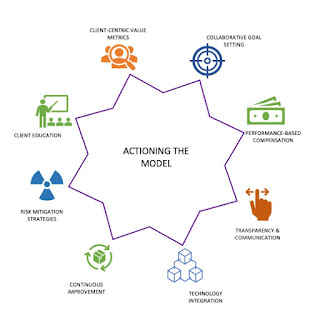
  Quite sometime back I had posted on LinkedIn an update mentioning, in the future, agencies will be offered value based compensation by clients. Few days back I met one of my ex-colleague and he gave his own POV and also asked me to elaborate on my thoughts. Albeit the delay, this long post is just that. Alright, so picture this: the ad agency game, a whirlwind of creativity and strategy. But here's the plot twist – the traditional billing method is feeling a bit outdated. For more than 50 years, everything in the agency has changed, except the retainer fee. It is like watching multiple seasons of a TV serial but with that one character who has not changed - in looks or in personality.   Having a retainer based fee is fine. I’ve nothing against it. It’s like trying to watch a blockbuster movie on a black-and-white TV. Sure, it works, but it's not quite cutting it anymore. The problem? The usual time-based billing doesn't always sync up with what clients really want – measu...

Revolutionizing Advertising

Image
  A Roadmap for Real-Time Personalization Campaigns Driven by AI and Data In the ever-evolving landscape of digital marketing and advertising, the convergence of technology, data, and AI is reshaping the industry. A paradigm shift towards personalization and real-time experiences has become the new norm. In a recent McKinsey report on personalization at scale ( https://www.mckinsey.com/business-functions/marketing-and-sales/our-insights/a-technology-blueprint-for-personalization-at-scale ), four key pillars were identified: Data, Decisioning, Design, and Delivery. While Data, Decisioning, and Delivery have seen significant advancements where big technology and consulting players - Adobe, Salesforce, Google, to name a few, are making great strides, the Design aspect remains a manual and resource-intensive process. This presents a unique opportunity for creative advertising agencies to revolutionize the industry. The untapped opportunity lies in addressing the Design pillar of person...