Posts

Digitalization: Effect of it on the eco-system

The recently concluded Copenhagen summit on climate change and non-conclusion of the countries on any accord made me wonder what could be the thing that can bring about a change in the eco-system… The answer was staring on my face. Digital. The growth of Internet and Mobile has been so phenomenal; I guess today most of us cannot imagine a life without this two. Most of the stuff we do in our professional or personal life is eased due to the use of these technologies. Some of the areas that will have direct impact of digital would be: - Travel & Transport - Automotive - Entertainment - Shopping & Banking - Media Trends rising out digitalization of our world: - We will travel less for work or personal reasons. In fact most of my work can be done Out of Office. Similarly, as we shift more and more into services economy from manufacturing economy…. Digital would help in fulfillment thus reducing the need of physical presence. Video Conferencing especially in the personal space – Fr...

What makes social networking sites ‘click’

As we approach the end of another year, there would be multitudes of new people who would have joined some social networking site or other. Well, there are dime and dozen reasons for the success of Social Networking Sites like Facebook, Twitter, Myspace, Orkut, etc…. but is there any common thread or insight that binds the success of these SNS sites? We humans spend most of our waking hours in building and maintaining ‘relationship’. This behavior is embedded in our genes. The activity of ‘grooming’ in primates, a human child crying for attention, the activities we, as adults, do in our day to day life – like the friendly greeting to colleagues, the discussion over cup of coffee, meeting the client deadlines too :) - All these actions is related to building and maintaining relationships. One of the core objective of building and maintaining relationships is to create an opinion about oneself in others mind. The way we talk, what we speak, the way we dress, the way we walk, all communic...

is the Yahoo! advertising campaign working in India?

Image
The Yahoo! ad campaign in India is on for about 4 months... (Its You campaign)... I was wondering how successful this campaign has been in terms of increase in users of Yahoo! India, and also in terms of visitors to the site... While I have no authentic data on the above, a quick glance into Google Trends for Yahoo India website gives a very sorry picture.. The chart shows a steady decline in the Unique visitors to the Yahoo website since starting of 2009... While one thing to note is that Google Trends do not consider sub-domain, and will only be tracking the TLD (Top Level Domain).. it still is not a good sign for Yahoo! This resonates with my thoughts that Internet Time is a limited resource for the users in India... The growth in usage of social networking sites is cannibalizing into the usage of other Internet websites.. A Google trend chart (given below) on Facebook & Twitter would confirm its rising popularity. While I wait for authentic source of information - I would go wi...

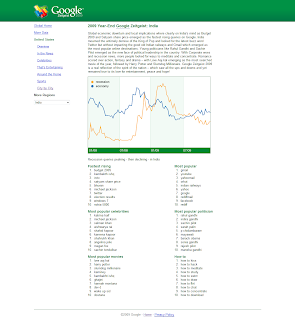
Google Zeitgeist for India – 2009

Image
Google has released the latest Zeitgeist for 2009. While the overall results shown are predictable (basis the different headers)… there are some things which were interesting. Let’s have a quick recap of important happenings in India over the past one year – - General Elections (by far the biggest event) - Indians win at Oscar - The Budget presentation (during the time of recession) - Interest in the Economy (the ripple effect of the global economic scenario) - And of course: the staple diet of most Indians – movies, cricket, celebrities Google search queries correlate to the above happenings with Budget 2009, Election Results, Slumdog Millionaire etc., all being the top search queries of the year. However, some interesting search queries too were to be seen. ‘Bhuvan’ too was seen to be the fastest growing search query. Launched in Mid-August, Bhuvan, the ISRO’s Geo-satellite, which can zoom to 10 square meter (similar to Google, or Wikimaps), would have been of interest to many. I hav...

The (Media) Empire to strike back

Are we at a cusp of media upheaval? Are we soon going to see a war betting the old (traditional) media vs. new (Online) media?? Rupert Murdoch, speaking at the World Media Summit in Beijing, was mentioning that Search Engines and other content aggregators need to pay for any news reports or articles they currently take for free He said “The aggregators and plagiarists will soon have to pay a price for the co-opting of our content”. A Media Mogul whose company owns newspapers, other publications and TV channels across the globe, his view comes as ominous. He was particularly harsh on Search Engine like Google, Yahoo! And other websites like Wikipedia, YouTube and Facebook While Mr. Murdoch and other media companies are right that there is a price for the content they create. As content owners they need to be compensated for exploitation of the original content for commercial purpose. Having started my career with a media company, I have been taught and now know that there is nothing ...

Truth about blogging and bloggers in India

A curiosity to know how many ‘active’ bloggers are there in India and a quick Google search gave me stats that are pretty old and seemingly unauthentic. A WATBlog article has a report dated 2007 mentioning that 14% of Netizens from India are into ‘active’ blogging. Here I’m assuming that by ‘active’ they would mean someone who updates his/her blog at-least once a month. On a safe assumption that we have now about 60 Million Internet users in India and the blogger universe average dropping to 10% - still it talks about 6 Million bloggers in India. In the same article reference to another and a much more older (2006) Government of India report says that there are about 40K active bloggers and with another 400K ‘not regular’ bloggers. A safe assumption that the number of bloggers being directly proportional to the increase in the net users would mean we would be having a universe of close to 1 Million active bloggers from India. The most interesting part of this article was the survey co...

Social Networking & Dunbar's Number

My Facebook friends list has reached close to 140 (give or take 3 pending requests). One of persistent thought I have been having for past few days is the fact that the number of people in my social network is close to Dunbar’s number (148 appx) – my neocortex limit for maintaining stable relationship Dunbar's number (also known as the Dunbar number or the Monkeysphere) is a value significant in sociology and anthropology. Proposed by British anthropologist Robin Dunbar, it measures the "cognitive limit to the number of individuals with whom any one person can maintain stable relationships". Dunbar theorizes that "this limit is a direct function of relative neocortex size, and that this in turn limits group size ... the limit imposed by neocortical processing capacity is simply on the number of individuals with whom a stable inter-personal relationship can be maintained." You could read more about Dunbar’s number at (http://en.wikipedia.org/wiki/Dunbar's_nu...