Posts

Showing posts with the label Twitter

What's Really Killing Twitter

Image
I first joined Twitter in 2007, thanks to a client campaign activity, and was managing and maintaining their Twitter handle for few months. A year later, I personally got active on Twitter.  My Twitter experience has been 3 stages.. Stage 1: Era of egghead DP & many personal tweets. Yes, it was that time in India, when you could send your tweet through SMS, using a basic feature phone. Stage 2: An era of relevancy… when most fake profiles disappeared from the follower list, the tweets were relevant to the news/topics/people that were of interest to me,  Stage 3: Era of confusion.. Today, I’m not sure why my Twitter timeline means to me. It is a hotchpotch of GIFs, Videos, crazy #tags, irrelevant tweets Of late, Twitter has been in the news for all the wrong reasons… Their earnings are down User base is mostly stagnant and in some geos contracting A lot of senior management people are leaving These are signs of an organisation that is ill, ...

People & Brand - The ‘Heard’ Mentality

Image
Here I want to talk about, why people use social media & what brands can learn from that A brand is nothing but individual thoughts of a collective set of people. And, people are,well, people :) Which means, in real world,  brands in many ways behave the way people do. Same is behaviour when it comes to social media too People get on to social media platforms, especially networking platforms, to connect and converse with people. They love to share stories, occasions, and have a general good time catching up. Isn’t this the purpose, why we all landed up on Facebook and Twitter initially?  But somewhere down the road, as we tend to become more (social) media savvy, our focus shifts from engagement with people we know to acquisition. Our inherent desire on social media, becomes that of acquiring more followers, fans, or increasing the connections (as in LinkedIn).  Call it ‘heard’ mentality. It is more important that how many hears you rather th...

Why Brands Should Follow on Social Media

Image
E very Brand out there on social media wants huge number of people or fans following them. Even then analytics talking about brand page popularity in social media - decides it on their reach and followers. A quick look on their Facebook page or Twitter profile shows how many Million followers/fans they have (source: www.socialbakers.com ) Image 1 Facebook Best Brands (global)   Image 2 Twitter Best Brands (global) One obvious column that most miss are how few people the brands are actually following (in Image 2) Traditionally, brands have been built like the way great Empires were built in the past. It is the length, breadth, and the populace they cover that matter. Similarly, one important aspect of any marketing campaign is “REACH”. And, Hey! did it ever occur that we call the marketing activities as ‘campaigns’ - as in Military operations, and its etymology is rooted in the Latin word - Campus/Campia, meaning wide open fields  Since, Milit...

Sales and Social Media

Image
L ast week Adage ( www.adage.com ) came out with a news article stating that Coca-Cola Company study finds no sales impact (lift) from online chatter (For more details you could read the article here http://adage.com/article/cmo-strategy/coca-cola-sees-sales-impact-online-buzz-digital-display-effective-tv/240409/ The article goes on to detail the study and the client input that Online advertising do work, and that social media plays a crucial role...However, some interesting pointers from the article: Can you link sales objective (especially short term) with social media, especially when it comes to FMCG or CPG? I say, plain stupid to even try and spend time seeking such results. This can only be successful, if there is social media led tactical campaigns to drive sales... Overall sales depends on the time, distribution, space (shelf), competition activities, price, etc What should your social media objectives be? No silver bullet here. But for a FMCG or CPG brand; it should be m...

Lessons marketers can learn from "why this kolaveri di"

Image
Some of my thoughts on Why this kolaveri di phenomenon. With over 24 Million views on the original video, (plus an equal number of views on the various versions of it)this have become a true viral/meme case-study from India. No more reference to the Microsoft-Pankaj Udhas 'viral' or any of those 'foreign' case studies. Added to it are dedicated Facebook pages and millions of search results trying to bask in the glory of WTKD (including this blog :D) If one looks in deep, this song had all the makings for becoming a viral success. Any digital marketer could learn from the success of WTKD song. Here are some of the recipes that went into making this an success: Simplicity: A song with least common denominator English words regularly used by the youth with couple of simple vernacular words... the song has the universality of nursery rhymes like, Twinkle, Twinkle Little star.... or a Johnny, Johnny, Yes Papa.. With no music knowledge required, little wonder anybody ...

Has Social Media come of age?

One of the main characteristic of any mass media is its ability to impact the society. Be it the newspapers, television or radio, each had played its part, in terms of changing views and shaping the society. In the recent past, there have been many news articles about the impact of social media in the civil society movements… Be it Coffee Party in America, The elections in Iran, the civil movements in Tunisia, Egypt (#Twitterrevolution) and other Arab countries...or, closer home, the Team Anna’s anti corruption movement in India…. Social media usage has become an important tactic in terms of spreading awareness and mobilizing support. The question is - has social media come of age? If you look at the history of mass media… it has always been associated with politics. In fact, it is referred to as “fourth estate”, the other 3 being Executive, Legislative, and Judicial. Traditional mass media was and has been controlled by a few (Just imagine, more than 90% of mass media consumed ...

Ancient Archetypes in Modern Media

Image
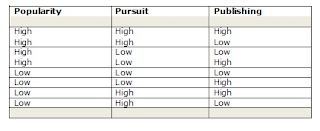
Today is the age of personal media ownership. According to a recent news release from Twitter (http://blog.twitter.com/2011/03/numbers.html) on an average around 4 Billion tweets are sent out every month. From individual point of views, re-tweets, status updates, what’s happening?, and direct messages….Twitter has become the favourite platform for self-expression for many Every Twitter account can be measured on the following parameters – Popularity – The number of people following a twitter profile Pursuit – The number of people whom a twitter profile is following..either for information or interaction Publishing – The volume of tweets (original) and re-tweets being done by the profile Basis the above 3 P’s mentioned, we can organize the twitter users into different groups…and each group fit into the classical Archetype. The Twitter grouping: On the X- axis is broadly the values of Popularity/Pursuit (for ease of grouping have grouped into 3 categories – less than 1, equal to 1, and...

The Importance of “Positioning”

The online would have enough and more dope on Brand Positioning; So, I'd not go into the detailing of what is positioning, and how it can be achieved? I will also not talk about the Importance of Positioning but would try and give some examples of some brand names you are familiar with and interact on day to day basis in the online space. Couple of days back, I was talking to a brand manager who was mentioning how the online platforms are only best suited for tactical purposes. He went onto mention that maybe in future "positioning" would not be a marketing focus, and "being tactical" would be the marketing strategy of the day. I argued, on the importance of positioning, and had taken couple of examples from the Internet space and said if online companies are focusing on positioning, then 'positioning' is and will be crucial aspect of marketing. While there is a grain of truth in saying that in future "being tactical" would be important…since n...

Technology – Building Bridges or Building Walls?

Image
This can be part – 2 of my earlier blog on how technology affects human behaviour. Couple of things that has come to my notice in the past few days made me think… is the popular technology more of a communication enabler or disabler? A colleague of mine has recently been to Singapore for holidays. An interesting observation, he mentioned, was that how people seem to be in their own world – the ear phones plugged, listening to their ipods, mobile phones, etc… or they were busy fidgeting with their mobile phones, either playing games or watching some video on the phone/ipod. They seem to be in their own world as if they have created an invisible wall around them. Another is a report that was mentioning about the increase of mobile VAS. Currently the mobile VAS contributes to 12% (in India) of the revenue. While text (SMS) seems to be the major revenue generator in VAS services, contribution from other VAS sources like – Music downloads, Ringtones, Caller Ring Back Tone (CRBT), screensav...

Follow Finder from Google Labs - Any takers??

I saw this new stuff that Google Labs is working on… FollowFinder it made me curious to know what exactly does this feature do, and how will it help the users and also how will it help Google as a company. Followfinder is basically a search engine that will help you find people (nay, tweeps) and expand your twitter network. While I’m not sure why would people go to a Google feature to search for Tweeps, while I have this function on Twitter page… in terms of finding people. In fact looking at the growth of twitter access through mobile apps (I guess in the last count it was close to 45%) Google is looking at only half the twitter user universe through this feature… Another reason and I find this most stupid is the fact that if I am following say 2 publication tweets…what inference makes Google believe that I might be interested in other publication tweets too.. I mean, I do not subscribe to all the newspapers or magazines.. I stick to 1 or 2… and I’m sure most people also would be hap...

5 Skill-sets that would be in demand in Digital Marketing for 2010:

2010 has started off with a lot of promise when it comes to digital marketing. I have seen a sea shift in terms of the clients pro-actively seeking digital marketing ideas and solutions from the agencies. Some reasons for the same could be: - The user base of internet has grown to an extent, it can be called as a mass media. Reports say that the Internet users in the country is over 71 Million - The traditional news mediums (TV and Print) are quoting from twitters and blogs that has increased the awareness of these platforms. Quotes (nay tweets) from popular personalities (nay tweeps) are the source of information and content for many of the newspapers and TV channels… What iamsrk is saying, or the recent tweets from iplt20 (Lalit Modi) and shashitharoor has made twitter a household name.. - A phenomenon called Facebook has spread like a pandemic. In today’s world – People have started taking up professions which most will never plan to do in their real life – Farming, Cooking, Mob…et...

How Microsoft Bing 'Farmed' for new users

I had got this interesting article from WebProNews... More people use Farmville than Twitter, according to Bing, and People are sharing all kinds of activities within Farmville itself. That's why the company saw a great opportunity to experiment. What they did was offer a special offer inside of Farmville, that would give users free "farm cash" if they became a fan of Bing on Facebook, which would encourage continued user interaction with Bing. As a result: - Over 72% of users who clicked on the engagement became fans - 59,000 people published the story to their news feed - Over 70,000 clicks were received on secondary feeds - In 24hours, Bing had over 400,000 new fans to keep Microsoft said its goals for engagement and social media efforts have been to: - Add or create relevant value (stuff that's not even necessarily a Microsoft property) - Add depth to Bing's personality - Lead someone to a relevant engagement with Bing or each other. - Yield passionate or emot...

Will the Buzz drown the Tweets??

Image
Since the time it launched few weeks back, Google Buzz has been just doing that. Creating Buzz… While the critics are mentioning about the privacy issues (Facebook too had faced privacy issues about a year back), many have started experimenting with this new platform… For Google, it was necessary that they integrate the Buzz with their ‘star performer’ – Gmail (search engine being the sacred cow they cannot fiddle with). Google has been dabbling in the social media space for past many years, but somehow the success has been elusive. Their strike rate in social media is close to zero. While Orkut is popular in Brazil and India… but in markets that matters, they hardly have been able to make a dent. Flickr has far more traction amongst the online users that Picasa…and Google Wave just managed to create a ripple. Twitter, since it hit the market in 2006, has been gaining popularity worldwide. The reasons for the same can be attributed to the following: - Simplicity: Most people are normal...

Twitter: Connection Generator or Content Generator

I’m sure the following scenarios would be familiar to most people… If you look carefully at what is being said or written in the Media (Television / Newspapers)… news on “My Name is Khan” – the movie, about Shah Rukh Khan’s comments and many other related titbits. Few months back it was Sashi Tharoor and about what he said (the cattle class comments), and what he was saying thereof. Another regular feature in the news channels happens to be what the latest tweets are on specific topics or current events… suddenly you see that Twitter is also about content… The idea of Twitter was to provide a simple platform for the online users to update their status; and for their friends and followers to see and respond. The idea of keeping it under 140 characters was to make the integration with existing SMS platforms easier…. The idea has been very successful, and people have started taking on to Twitter a big way… The stats say that almost 40-45% of Twitter traffic is from Mobile platforms and th...

Back to tribalism: Future lies in the past

No one will argue the fact that we all live in a networked world. You connected to me, connected to another, and another, and to the whole world. True? Well, not quite. Take a detailed look into this networked world; you will find that it is a chain of islands, with spaces between each other…. It is islands of online communities, groups, niche networks, etc… You realize that this online world (especially the social networking) is not one big homogeneous society, but a collection of different types of groups. But looking at our past we know that human advancement has been on basis of creating a homogeneous society… From being a small group of hunters and gatherers, to forming large communities, building villages, city states, empires, and to nation states of today… Now that we have the technology and the medium to create this homogeneous society, even if it is online, why do we shy from doing so? If we look back at the start of the Internet – it was a repository of information that can ...

What makes social networking sites ‘click’

As we approach the end of another year, there would be multitudes of new people who would have joined some social networking site or other. Well, there are dime and dozen reasons for the success of Social Networking Sites like Facebook, Twitter, Myspace, Orkut, etc…. but is there any common thread or insight that binds the success of these SNS sites? We humans spend most of our waking hours in building and maintaining ‘relationship’. This behavior is embedded in our genes. The activity of ‘grooming’ in primates, a human child crying for attention, the activities we, as adults, do in our day to day life – like the friendly greeting to colleagues, the discussion over cup of coffee, meeting the client deadlines too :) - All these actions is related to building and maintaining relationships. One of the core objective of building and maintaining relationships is to create an opinion about oneself in others mind. The way we talk, what we speak, the way we dress, the way we walk, all communic...

is the Yahoo! advertising campaign working in India?

Image
The Yahoo! ad campaign in India is on for about 4 months... (Its You campaign)... I was wondering how successful this campaign has been in terms of increase in users of Yahoo! India, and also in terms of visitors to the site... While I have no authentic data on the above, a quick glance into Google Trends for Yahoo India website gives a very sorry picture.. The chart shows a steady decline in the Unique visitors to the Yahoo website since starting of 2009... While one thing to note is that Google Trends do not consider sub-domain, and will only be tracking the TLD (Top Level Domain).. it still is not a good sign for Yahoo! This resonates with my thoughts that Internet Time is a limited resource for the users in India... The growth in usage of social networking sites is cannibalizing into the usage of other Internet websites.. A Google trend chart (given below) on Facebook & Twitter would confirm its rising popularity. While I wait for authentic source of information - I would go wi...

Google Zeitgeist for India – 2009

Image
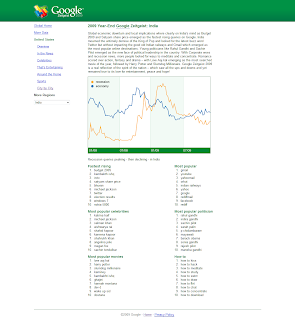
Google has released the latest Zeitgeist for 2009. While the overall results shown are predictable (basis the different headers)… there are some things which were interesting. Let’s have a quick recap of important happenings in India over the past one year – - General Elections (by far the biggest event) - Indians win at Oscar - The Budget presentation (during the time of recession) - Interest in the Economy (the ripple effect of the global economic scenario) - And of course: the staple diet of most Indians – movies, cricket, celebrities Google search queries correlate to the above happenings with Budget 2009, Election Results, Slumdog Millionaire etc., all being the top search queries of the year. However, some interesting search queries too were to be seen. ‘Bhuvan’ too was seen to be the fastest growing search query. Launched in Mid-August, Bhuvan, the ISRO’s Geo-satellite, which can zoom to 10 square meter (similar to Google, or Wikimaps), would have been of interest to many. I hav...

Truth about blogging and bloggers in India

A curiosity to know how many ‘active’ bloggers are there in India and a quick Google search gave me stats that are pretty old and seemingly unauthentic. A WATBlog article has a report dated 2007 mentioning that 14% of Netizens from India are into ‘active’ blogging. Here I’m assuming that by ‘active’ they would mean someone who updates his/her blog at-least once a month. On a safe assumption that we have now about 60 Million Internet users in India and the blogger universe average dropping to 10% - still it talks about 6 Million bloggers in India. In the same article reference to another and a much more older (2006) Government of India report says that there are about 40K active bloggers and with another 400K ‘not regular’ bloggers. A safe assumption that the number of bloggers being directly proportional to the increase in the net users would mean we would be having a universe of close to 1 Million active bloggers from India. The most interesting part of this article was the survey co...

Social Networking & Dunbar's Number

My Facebook friends list has reached close to 140 (give or take 3 pending requests). One of persistent thought I have been having for past few days is the fact that the number of people in my social network is close to Dunbar’s number (148 appx) – my neocortex limit for maintaining stable relationship Dunbar's number (also known as the Dunbar number or the Monkeysphere) is a value significant in sociology and anthropology. Proposed by British anthropologist Robin Dunbar, it measures the "cognitive limit to the number of individuals with whom any one person can maintain stable relationships". Dunbar theorizes that "this limit is a direct function of relative neocortex size, and that this in turn limits group size ... the limit imposed by neocortical processing capacity is simply on the number of individuals with whom a stable inter-personal relationship can be maintained." You could read more about Dunbar’s number at (http://en.wikipedia.org/wiki/Dunbar's_nu...